
*Note: Not Advanced Placement, but rather Afro-Pessimistic
March 21, 2022
“The Human need to be liberated in the world is not the same as the Black need to be liberated from the world…
[b]ecause what are they trying to do? They’re trying to build a better world. And what are we [black] trying to do? We’re trying to destroy the world. Two irreconcilable projects.”
Frank B. Wilderson, III
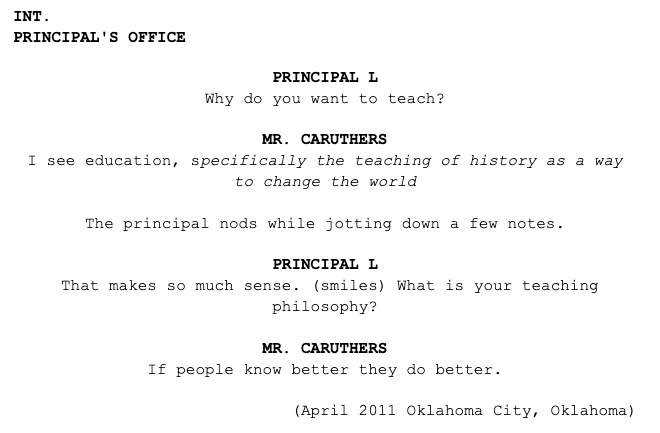
If I am to be kind to myself, I would simply state that I was naive. I was just 23 years old when I believed that by teaching history I could change the world. What about the world I wanted to change was vague and left uninterrogated by the principal that interviewed me for my first teaching job back in 2011.
I thought that if people knew about past wrongs they would “do better.” So my teaching philosophy hinged on this notion that if people “Know better, they do better”
Eleven years later I can admit that I have gained a devastating level of clarity about the world I wanted to change.
My clarity begins with thinking with slavery and its ever expanding archive. Knowing and understanding that slavery wasn’t a simple lapse in moral judgement but rather a paradigmatic shift in how the entire world would relate to Africans and their “blackened humanity.” This new way of relating continues into the present.
Time unwinds, bends, and extends around and through new world slavery. It maps out how students understand their geography courses and it formats the units of United States History, World History, Government, and European history both on level and AP.
A clearer vision now presents itself to me when I enter the classroom because I am a “blackened” history teacher.
The slave is the visible and invisible hand steering social studies curriculum.
And so, my vision sharpens when I take up the figure of the slave. As it is the driving force behind European conquest of the Americas, behind the creation of the Virginian, behind the uttered phrase of “no taxation without representation” and declarations of independence. The slavers demanded freedom from their British masters. American slavery is American freedom.
The figure of the slave and a revolution for freedom fully realized in the Haitian made the Louisiana Purchase possible.
It moved west with Lewis and Clark. It was the glue between the sectional crisis and several compromises. It was the reason for the Nullification Crisis, the caning of Sumner and a war between the masters in the North and masters in the South.
The slave made reconstruction necessary and gave the “world” the wealth to wage its wars of the 20th century.
It’s the slave that made representation a fool’s goal after 1968.
And it’s the slave that gave us the modern world.
So when I return to my initial ideas surrounding the impact and reach of History education I can admit that AfroPessimism has removed the scales from my eyes and shown what is at stake. What I mean by that is best explained in the following conversation I recently had with my current principal:

So what does that mean for my return to public education? For starters, It means that I’m in direct opposition to current legislation that is being passed to ban the instruction of “critical race theory.” Which is the right’s cover for stopping any instruction that makes students critical of the United States and its morally corrupt empire.
It means I’m always already teaching Blackened history.
Written by Jefferson R. Caruthers, III
Edited by Chavonté Wright
For further Reading:
American Slavery, American Freedom by Edmund S. Morgan
The Half Has Never Been Told by Edward E. Baptist
Laboring Women: Reproduction and Gender in New World Slavery by Jennifer L. Morgan
Scenes of Subjection: Terror, Slavery and Self-Making in Nineteenth Century America by Saidiya V. Hartman
AfroPessimism by Frank B. Wilderson, III
We’re Trying to Destroy the world” Anti-Blackness & Police Violence After Ferguson An Interview with Frank B. Wilderson, III
As Free as Blackness Will Make Them by Frank B. Wilderson, III
Becoming Human: Matter and Meaning in an AntiBlack World by Zakiyyah Iman Jackson
Beloved by Toni Morrison
The Bluest Eye by Toni Morrison
Incidents in the Life of Slave Girl by Harriet Jacobs
Narrative of the Life of Frederick Douglass by Frederick Douglass
 BIKOCARUTHERS.COM
Leave a comment